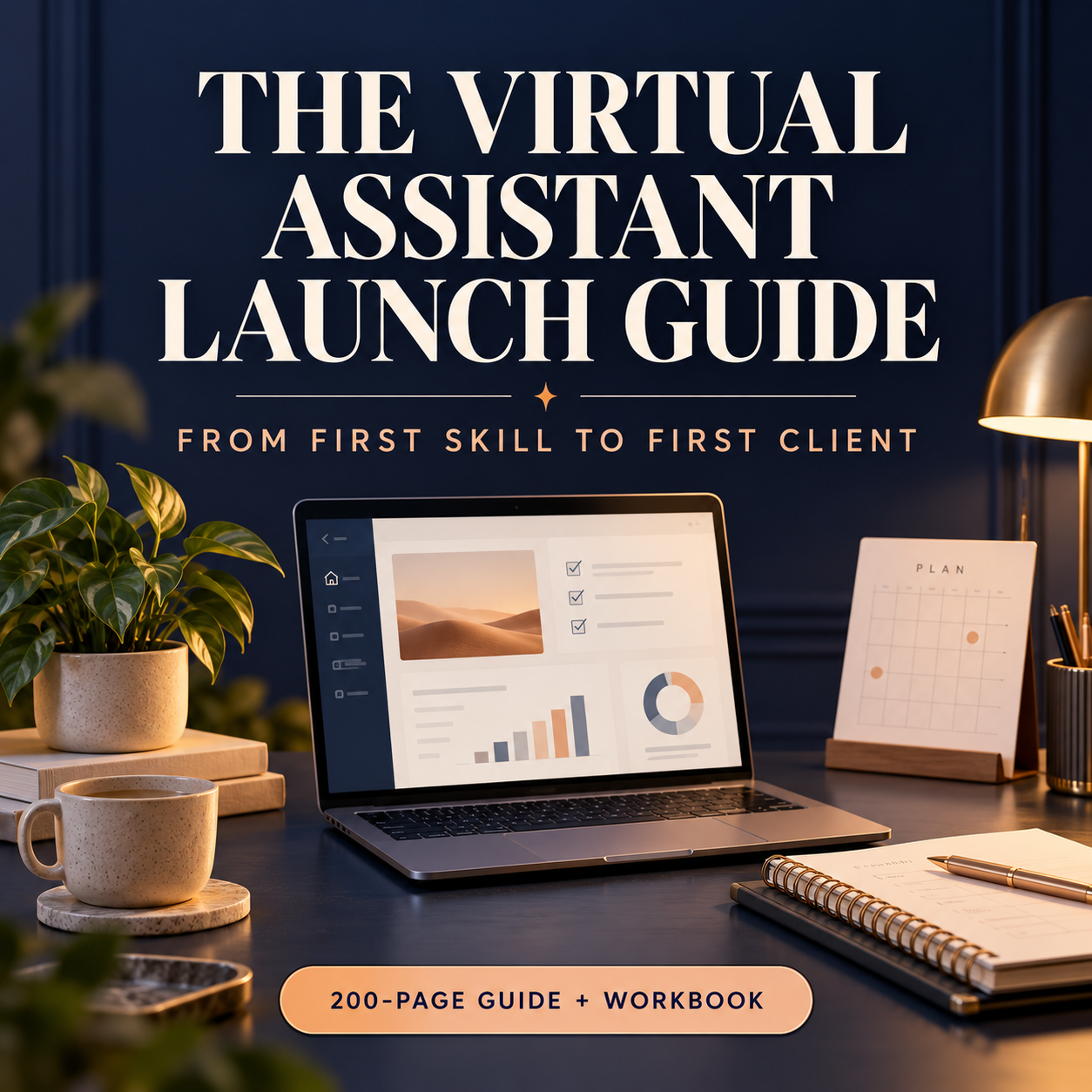
One-time purchase · Digital download through Gumroad
FROM FIRST SKILL TO FIRST CLIENT
A GUIDE TO READ. A WORKBOOK TO USE.200 PAGES
200pages, including practical working space
48chapters with lessons and examples
48copyable working templates
1clearer starting point for your practice
LESS GUESSING. MORE USEFUL PREPARATION.
Build the foundations of a professional service.
Learn what a VA does, choose work you can demonstrate, and prepare for the real conversations and responsibilities that come with clients.
01 / CHOOSE
An offer that fits you.
Assess transferable skills, choose a client type, set realistic availability, and define a service with a finish line.
02 / PROVE
Evidence you can show.
Create honest demonstration samples, write clear case studies, and build a profile without inventing experience.
03 / CONNECT
A considered client search.
Screen opportunities, recognize scams, write relevant applications, and prepare discovery calls and proposals.
04 / DELIVER
A reliable working process.
Set up intake, permissions, SOPs, communication, quality checks, boundaries, and a professional handoff.
YOUR FIRST SMALL DECISIONS
Where should you begin?
Select the stage that sounds like you. Each stage produces something you can use.
STAGE 01 / YOUR OFFER
Start with one useful service.
You do not need a huge menu of untested skills. Identify one recurring task you can perform, check, and deliver within your actual availability.
YOUR PRACTICAL OUTPUT
A one-page offer card: client, deliverables, volume, timing, required inputs, and exclusions.
The book's 30-day plan is a planning structure, not a guarantee of hiring or income.
THE COMPLETE ROUTE / 12 PARTS
From “where do I start?” to “here is my process.”
Every chapter has four pages: a lesson, a fictional worked example, an action workflow, and a working page with a copyable template.
IStart with a realistic planChapters 01–04 · pp. 7–22+
What a virtual assistant actually does
Find transferable skills without exaggerating
Make room for a sustainable working schedule
Learn by producing useful work
IIChoose a useful offerChapters 05–08 · pp. 23–38+
Understand a client before naming a service
Select beginner services you can demonstrate
Choose a niche without locking yourself in
Package an offer with a clear finish line
IIISet up to work professionallyChapters 09–12 · pp. 39–54+
Build a reliable remote workspace
Organize files so another person can find them
Protect accounts and client information
Choose a small tool stack and use AI carefully
IVLearn the core administrative workflowsChapters 13–16 · pp. 55–70+
Support an inbox without taking over decisions
Coordinate calendars across time zones
Research with sources and useful uncertainty
Prepare documents and meeting notes people can use
VExpand your practical service skillsChapters 17–20 · pp. 71–86+
Maintain spreadsheets with a checking process
Keep a CRM useful and current
Support customers with empathy and boundaries
Prepare social content without inventing claims
VIBuild credible proofChapters 21–24 · pp. 87–102+
Create portfolio samples before your first client
Write case studies that explain decisions
Write a profile that makes your offer clear
Build a simple portfolio page
VIIPrice and scope your workChapters 25–28 · pp. 103–118+
Understand the arithmetic behind your price
Choose hourly, project, or recurring pricing
Control scope, revisions, and change requests
Invoice, record payments, and check local obligations
VIIIFind suitable opportunitiesChapters 29–32 · pp. 119–134+
Choose channels and recognize scams
Research prospects respectfully
Write outreach that respects the recipient
Apply to jobs with evidence and fit
IXTurn a conversation into a clear agreementChapters 33–36 · pp. 135–150+
Run a useful discovery conversation
Write a proposal people can compare
Handle questions, objections, and a paid pilot
Prepare for a service agreement
XOnboard without chaosChapters 37–40 · pp. 151–166+
Collect the right information at intake
Set up access and permissions deliberately
Write a standard operating procedure
Hold a kickoff and plan the first week
XIDeliver reliably every weekChapters 41–44 · pp. 167–182+
Prioritize work and manage your task queue
Communicate status before people have to chase
Check quality before handing work over
Handle mistakes, delays, and difficult situations
XIIBuild a sustainable practiceChapters 45–48 · pp. 183–198+
Retain clients through useful reviews
Manage capacity, boundaries, and growth
End an engagement professionally
Build your 30-day launch plan
READ. APPLY. REVIEW.
Make the guide your own working plan.
Follow Maya, a fictional beginner, as she defines a bounded meeting-support service for a fictional studio. Then adapt the working pages to your own skills and circumstances.
“I help CLIENT TYPE with SPECIFIC TASK so they can use DELIVERABLE.”
YOUR NEXT DECISIONS
What can you demonstrate? What will the client approve? How will you know the work is complete?
The guide includes 48 working pages, also supplied as a separate printable PDF.
YOUR DIGITAL DESK REFERENCE
The guide. The working pages. The editable toolkit.
200-page main PDF with clickable contents and bookmarks
48 lessons, worked examples, workflows, and exercises
48 working pages in a separate printable PDF
48 working templates in Markdown, TXT, and JSON
Editable manuscript, launch planner, and official resource links
The separate working pages and toolkit are convenience copies of material included in the book, not additional unique lessons.
BEFORE YOU BEGIN
Useful answers.
Is this suitable if I have no VA experience?+
Yes. The guide starts with transferable skills and a realistic starting offer. It shows how to build clearly labeled demonstration work without claiming experience you do not have.
Is it written for a particular country?+
It is written for global beginners, with USD examples. Local registration, tax, classification, agreement, privacy, and recordkeeping requirements must be checked for your situation. The guide does not replace qualified advice.
Does it guarantee a client or income?+
No. It provides a practical preparation and delivery process. Hiring, client response, and earnings depend on many factors. The thirty-day plan organizes actions, not guaranteed outcomes.
What does the 200-page count include?+
The main PDF contains exactly 200 pages: cover, reader guidance, contents, roadmap, fictional case context, 48 four-page chapters, glossary, and resources. Forty-eight of those pages are working pages with writing space.
Can I adapt the templates for client work?+
Yes. Adapt them for your own business and client services. You may not redistribute or resell the book or a substantially similar toolkit. The agreement worksheet is a preparation aid, not a ready-to-sign legal contract.
How will I receive the files?+
Gumroad supplies the main PDF and complete ZIP after purchase. The ZIP includes the printable working pages, editable toolkit and manuscript, launch planner, and resources. No physical book is shipped.